Puzzle
Recruit
★★
- Joined
- Oct 11, 2025
- Posts
- 134
Today I would like to discuss some data and how it can say things that are different from what it actually is. Some of you may have already seen this graph, which shows that men all prefer younger women, but that women supposedly prefer men who are more or less the same age.
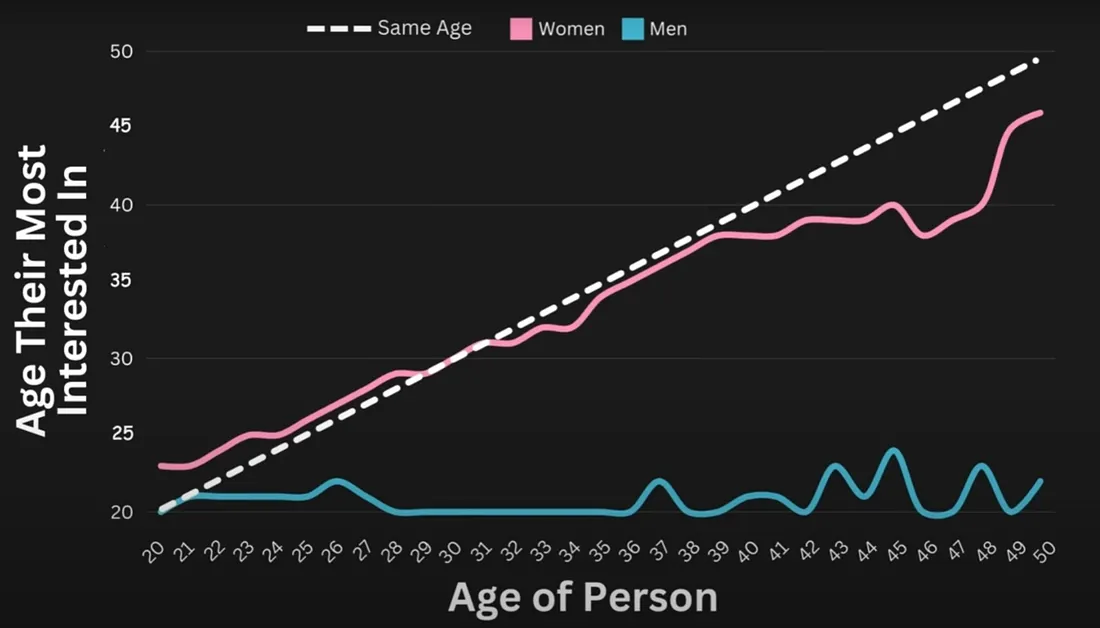
Here is the problem. It's impossible for women to have developed a preference for men of the same age if men haven't done the same. There is no plausible way for this to happen , it's an evolutionary impossibility , which tells us one thing: women don't prefer men of the same age. To go further, let's take a look at another piece of data :
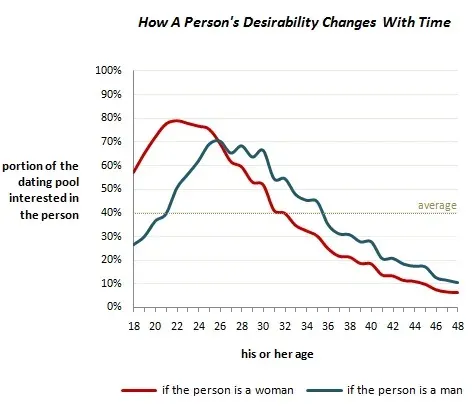
Notice how women peak at age 21, but also notice how they decline sharply after age 25, passing their peak attractiveness at age 31. However, also note how men seem to peak at age 25, then begin to decline around age 30, passing their peak attractiveness at age 36. According to this graph, it seems that no man ages like fine wine. Men and women seem to follow the same pattern, but women reach their peak earlier, which makes sense given that they develop more quickly than men.
NOW If women REALLY had a preference for men of the same age, as previously indicated in the graph, men cannot have a peak, but this data seems to indicate quite the opposite and it's between the ages of 25 and 30.
This raises the question: why does the first graph show that women prefer men of the same age? The reason is simple: it is the result of social dynamics rather than natural preferences. Women's “preference” for men their own age or older is a reaction to men's behavior, particularly on dating platforms that favor younger women :

This contributes to an asymmetry in the supply of messages: younger women receive more messages, while women of the same age as men receive less attention in the initial messages.
So, in this dynamic:
This may effectively push this 30-year-old woman to accept or turn to men her age, due to a lack of sufficient messages from them.
Here is the problem. It's impossible for women to have developed a preference for men of the same age if men haven't done the same. There is no plausible way for this to happen , it's an evolutionary impossibility , which tells us one thing: women don't prefer men of the same age. To go further, let's take a look at another piece of data :
Notice how women peak at age 21, but also notice how they decline sharply after age 25, passing their peak attractiveness at age 31. However, also note how men seem to peak at age 25, then begin to decline around age 30, passing their peak attractiveness at age 36. According to this graph, it seems that no man ages like fine wine. Men and women seem to follow the same pattern, but women reach their peak earlier, which makes sense given that they develop more quickly than men.
NOW If women REALLY had a preference for men of the same age, as previously indicated in the graph, men cannot have a peak, but this data seems to indicate quite the opposite and it's between the ages of 25 and 30.
This raises the question: why does the first graph show that women prefer men of the same age? The reason is simple: it is the result of social dynamics rather than natural preferences. Women's “preference” for men their own age or older is a reaction to men's behavior, particularly on dating platforms that favor younger women :
This contributes to an asymmetry in the supply of messages: younger women receive more messages, while women of the same age as men receive less attention in the initial messages.
So, in this dynamic:
This may effectively push this 30-year-old woman to accept or turn to men her age, due to a lack of sufficient messages from them.