I have to say this is an unusual question, one that I took quite some time to think about. So I thought about this mathematically.
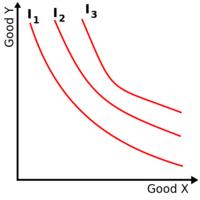
Have you guys ever seen an indifference curve? Microeconomists use it to model decision-making. It looks something like this:
View attachment 135561
One of the premises behind an indifference curve is that a consumer equally prefers every single combination of both goods on each line. A second premise is that a consumer strictly prefers to consume more of each individual good if the amount consumed of the other good remains constant. A logical consequence of this is that any combination on curve i3 grants strictly more utility to that consumer than curve i2, and curve i2 more than curve i1.
So I took the OP's question and set up a version of this model. See Figure 2.0:
View attachment 135566
OP's question is a microeconomic issue: each incel in this scenario has to make a trade-off between the attractiveness of a hypothetical girlfriend and her (lack of) loyalty. Would you rather be the girlfriend of a faithful 6/10 foid or an 8/10 who cheats once per month? Are you indifferent, or do you gain more utility from her attractiveness or more from her loyalty? Each incel's preference relations affects the slope of each curve; the negative slope of each indifference curve is known as the marginal rate of substitution (MRS). In other words, the MRS is the amount of a hypothetical girlfriend's attractiveness that an incel is willing to "sacrifice" in order to gain one additional unit of loyalty when that incel is at a specific point of the graph.
Look at Figure 3.0 below for the indifference curves of three hypothetical incels:
View attachment 135568View attachment 135569View attachment 135570
Albert is someone who cares deeply about loyalty. He is a based Muslimcel who thinks adultery ought to be punished by stoning, but of course, he is willing to make concessions for extremely attractive foids. Albert is indifferent between a faithful 2/10 foid and a 9/10 slut.
Ben is someone who occupies some sort of middle ground. He gains utility from increasing amounts of both variables. Ben is indifferent between a faithful 6/10 foid and a 9/10 slut.
Now, at each specific point on the graph, Albert's MRS is strictly greater than Ben's MRS; he is willing to sacrifice more attractiveness for one additional unit of loyalty.
Let's also look at Cuck. You will see that his indifference curves are horizontal. Why? It is because Cuck does not give a shit if a foid cheats on him; he would prefer a 4/10 slut over a faithful 3.9/10 foid. He might even gain utility from being cheated on. Cuck's MRS is zero.
So here is how you should answer OP's question. As an example, I will set up my own indifference curves in Figure 4.0:
View attachment 135572
At L1, a foid fucks Chads occasionally. At L2, a foid does the same, but you are allowed to veto some Chads. L1 and L2 correspond to the OP's 1st and 2nd scenarios respectively; in academic parlance, they are constraints.
Now, i1, i2, and i3 are curves that represent different levels of utility for me.
At i1, I am presented with negative utility; I would not accept any girlfriend offering any combination of attractiveness and loyalty along that line. At i3, I am presented with a great deal of utility; I would happily accept such a girlfriend. Any girl along curve i2 is where I am sort of indifferent between accepting such a girlfriend and rejecting her. You need to devise and figure out how your indifference curve i2 looks like; not i1, not i3.
Logically, your answer should be as follows:
To OP's first scenario, you would need to find the attractiveness level where your i2 curve intersects with line L1. To OP's second scenario, you would need to find the attractiveness level where your i2 curve intersects with line L2.
For me, I would accept any foid above 7.5/10 with the at constraint L1 (foid fucks Chads regularly). I would accept any foid above 6.5/10 at constraint L2 (foid fucks Chads but I have limited veto power).
Ceteris paribus, of course.
I hope this helped.