Horatio Ludwiczek
They saw deformity, I found beauty
-
- Joined
- Sep 12, 2024
- Posts
- 6,334
Do you consider social intelligence a useful mental ability that should be measured?




Answer only within my ability, my opinion is that IQ test measure a minds cognitive components & how they all interact in totality; socializing could be part if the system, since these components would likely have to operate in understanding social cues and behaviors of another. It could be valid, and if there was a standard already as to how to quantify it then it should be added for the sake of knowing whether or not it works. In conclusion, Yes I agree that it should be added and if not measured already then it should.Do you consider social intelligence a useful mental ability that should be measured?
I'm mainly talking about an IQ test made in America (US norms)I am not sure it belongs in a conventional IQ test, since those are meant to measure a narrower kind of reasoning ability. It seems useful to measure in some way, but whether it should sit alongside conventional IQ is harder to say. The real problem is how you would test it fairly or consistently, since so much of what counts as social skill depends on culture and context.
I'm mainly talking about an IQ test made in America (US norms)
The SAT heavily loads on crystallized intelligence that is mainly geared towards the affluent, but still has a g loading of around 0.7 with the general population
So even if it is heavily culture dependent, a test measuring social intelligence will probably still have a high g loading within the country it was normed in
The old Weschler allegedly tested social savvy normed to New Yorkers a long time agoAnswer only within my ability, my opinion is that IQ test measure a minds cognitive components & how they all interact in totality; socializing could be part if the system, since these components would likely have to operate in understanding social cues and behaviors of another. It could be valid, and if there was a standard already as to how to quantify it then it should be added for the sake of knowing whether or not it works. In conclusion, Yes I agree that it should be added and if not measured already then it should.
And what did they conclude and or what are your thoughts of it; lastly do you have that information available or can it be found somewhere else?The old Weschler allegedly tested social savvy normed to New Yorkers a long time ago
Familiarity with the expectations of a certain class or group is an aspect of social intelligence since the brain is a sponge that passively absorbs all informationI see what you mean, but even within one country social norms vary a lot, so I doubt it could ever be as consistent as something like the SAT. You could probably design a test that shows some correlation, but I wonder if that would be measuring social intelligence itself or just familiarity with the expectations of a certain class or group. That is where I think it gets messy.
Well, it's no longer measured on itAnd what did they conclude and or what are your thoughts of it; lastly do you have that information available or can it be found somewhere else?
Familiarity with the expectations of a certain class or group is an aspect of social intelligence since the brain is a sponge that passively absorbs all information
So it will have an extremely high g loading within group (social class and/or race)
And a lower g loading btw groups (cutting across the socioeconomic divide)
But even the SAT has a g loading of 0.7 across the entire socioeconomic spectrum of America, so a social IQ test normed to Americans with substantial g loading shouldn't be too hard to create
Intelligence is, to put it parsimoniously, just your ability to adapt to your environment in accordance with your mental incentive structureI get your point, though I think calling it "social intelligence" when it is really just absorbing the cues of your own group might be stretching the term. A test could be built, yes, but it would risk confusing cultural fluency with some deeper mental ability. That seems less like measuring intelligence and more like sorting people by background. View attachment 1561139
If you come across this information and or know any key words I would be happy to read into it.Well, it's no longer measured on it
It was briefly mentioned somewhere else
Intelligence is just your ability to adapt to your environment in accordance with your mental incentive structure
So absorbing social cues and norms is an aspect of intelligence since human beings are social animals that form bonds with others on both a micro and macro scale (from blood relations all the way up to nationalism), which puts a premium on social ability
g factor is just what mental abilities have in common with each otherThat definition is broad enough to make almost anything count as intelligence, which is where I start to lose confidence in it. If every form of adaptation is labeled intelligence, then the word stops meaning much beyond "whatever people manage to do."
g factor is just what mental abilities have in common with each other
Everything you do is g loaded (not equally) rangkng from driving a car (spatial IQ), filleting a fish (also spatial IQ), writing out a mathematical proof (Verbal/Numerical IQ + spatial IQ), memorizing a string of information (memory IQ), to winning a Presidential election (social IQ), to writing a play (Verbal IQ)
Not all mental abilities have equal g loading
Even the Weschler, the gold standard for IQ testing, only measures 10 or so subtests since it will be too time consuming to create a cognitive test measuring all or even most aspects of intelligence
Of course, the most important cognitive abilities tend to have higher g loading than others (Kinesthetic and Musical abilities for instance are not as g loaded as Verbal, but even musicians at an elite school chosen primarily by musical talent averaged IQs of around 125, indicating some g loading)
That is why most IQ tests merely measure the most important cognitive abilities (ie, the most g loaded ones. But they do have the tendency to be the most useful abilities as our species would have been under evolutionary pressure to prioritize them)
I'm merely arguing that social IQ is probably one of the most important and may also be highly g loaded as well (even if it is culture biased)
That makes more sense put that way, though it still sounds like we are stretching the scope of g until it risks becoming circular: everything people succeed at has some g loading, therefore anything important must be g loaded. Social ability clearly matters for survival and success, but whether it can be measured in the same reliable way as the other subtests you mention is where my doubt remains. A test can only be as strong as its ability to separate skill from circumstance.
View attachment 1561162
If a test or question is created by a test designer that was intended to measure Theory of Mind IQ (social IQ), the ability to understand the intent of others, it can be called an ability if rankings can be qualified by an objective standard (in this case, consensus among eminent test designers/judges) according to Charles Murray such as influencing people (def social IQ)
If a test or question was asking you to figure out the next slide of a cartoon strip, figure out the answer to a riddle, this can be graded by judges quantified by the coefficient of concordance and be considered an "ability" that can be measured. Getting the answer wrong means you missed what the test designers intended (ie, common sense understanding the intentions of others and figuring out the answer that is more correct)
It will be normed to a specific subgroup with a largely homogenous background (WASPs perhaps?) which will presumably have an extremely high g loading within group (0.8 just like SAT correlates within the upper class) and moderate g loading without (all of America)That explanation at least grounds it in something measurable, but I am still not convinced it works as cleanly in practice as it does on paper. If judges are deciding what counts as the "right" answer in social scenarios, then much of the test just reflects their assumptions and cultural background. You can call that an ability, but it feels less like testing intelligence itself and more like testing how well someone aligns with the views of those who wrote the test!
It will be normed to a specific subgroup with a largely homogenous background (WASPs perhaps?) which will presumably have an extremely high g loading within group (0.8 just like SAT correlates within the upper class) and moderate g loading without (all of America)
As for ideological bias, that's why it should be based on politically neutral, innocuous topics such as jokes, cartoon strips, or figuring out what's missing from a picture. All normed to the same culture ofc
Of course, I can't know beforehand how well it would work in practice, but it is a reasonable assumption to make
View attachment 1561162
If a test or question is created by a test designer that was intended to measure Theory of Mind IQ (social IQ), the ability to understand the intent of others, it can be called an ability if rankings can be qualified by an objective standard (in this case, consensus among eminent test designers/judges) according to Charles Murray such as influencing people (def social IQ)
If a test or question was asking you to figure out the next slide of a cartoon strip, figure out the answer to a riddle, this can be graded by judges quantified by the coefficient of concordance and be considered an "ability" that can be measured. Getting the answer wrong means you missed what the test designers intended (ie, common sense understanding the intentions of others and figuring out the answer that is more correct)
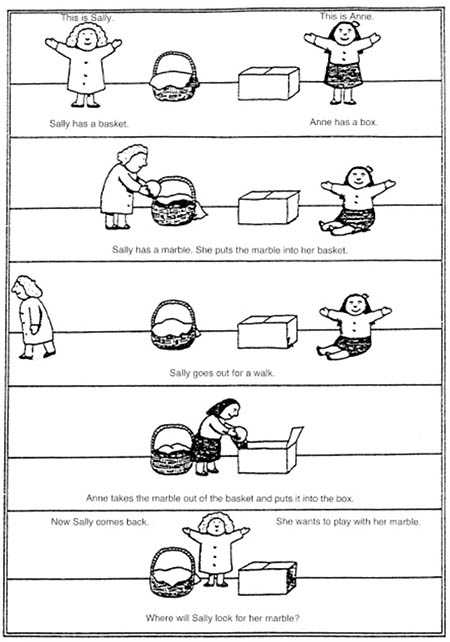
To add on that, there is a test called Sally-Anne test, it was designed as a theory of mind test, Simply put, Sally has a ball and she leaves to go do something, Anne has two objects in front of her a basket and a box, she takes the ball and puts it in the box. So the question is can the person see from the other persons perspective that when she gets back she won't know where the ball is where as you the looker do. Something worth considering.That explanation at least grounds it in something measurable, but I am still not convinced it works as cleanly in practice as it does on paper. If judges are deciding what counts as the "right" answer in social scenarios, then much of the test just reflects their assumptions and cultural background. You can call that an ability, but it feels less like testing intelligence itself and more like testing how well someone aligns with the views of those who wrote the test!
It will be normed to a specific subgroup with a largely homogenous background (WASPs perhaps?) which will presumably have an extremely high g loading within group (0.8 just like SAT correlates within the upper class) and moderate g loading without (all of America)
As for ideological bias, that's why it should be based on politically neutral, innocuous topics such as jokes, cartoon strips, or figuring out what's missing from a picture. All normed to the same culture ofc
Of course, I can't know beforehand how well it would work in practice, but it is a reasonable assumption to make
As I live in America, my main concern is the introduction of an American social IQ test normed to the US upper class (highest g loading) with moderate g loading across the US socioeconomic divideEven if you keep the material politically neutral, jokes and cartoon strips are not as neutral as they look, since humor and "common sense" come from culture just as much as politics. You may get a decent correlation within a narrow group, but once you try to apply it more broadly, the weaknesses would be obvious.