DarkStar
fuck it we ball
★★★★★
- Joined
- Nov 20, 2022
- Posts
- 29,980
- Online time
- 1m 37s
To begin with, the Mediterranean sea has served as a barrier between the various populations located on it:
 pmc.ncbi.nlm.nih.gov

 www.pnas.org
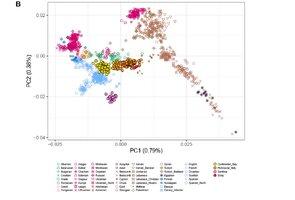
On PCA charts, although they are noticeably drifted from other Europeans, they still fall within the general cluster for Europe:


(Jews plot intermediary due to mixing)
FST wise they also are closest to other Europeans:


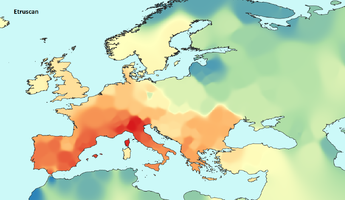
They also plot closely to the ancient Latini Romans & Mycenaean-Minoan Greeks


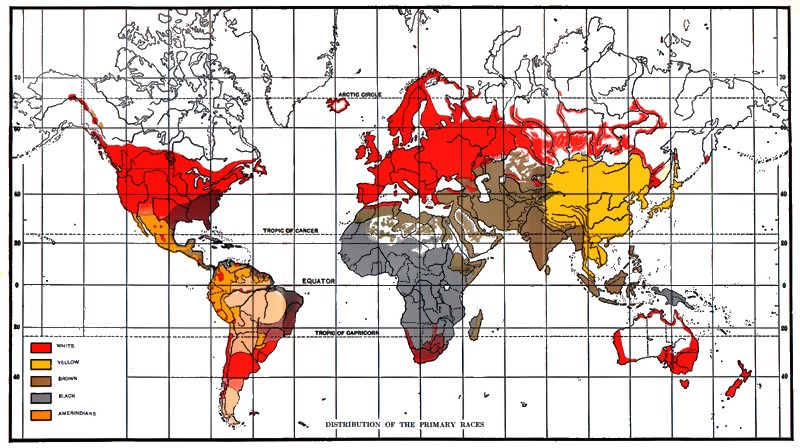
They also were always considered as White historically:
View: https://x.com/cremieuxrecueil/status/1952523100882682239

 www.amren.com
In historical times, there have been three major invasions of South Eastern Europe from the direction of the Near East but no evidence of major migratory events and gene flow. The Persians dominated South Western Asia in the fifth century BC: They established satrapies in Asia Minor and invaded Europe, but they were stopped by the Greeks (32). The Arabs attempted multiple invasions during the seventh and eighth centuries AD, but they were stopped by the Byzantines (33). An Arab tribe originating from Andalusia established in Crete a pirate state in the ninth century, but they were exterminated by the Byzantines 140 y later, and they left no traces of settlement in the island other than the name of their seat of power in the town of Chandax (33). The Turks invaded Asia Minor starting the 11th century and occupied the Balkans in the subsequent three centuries, but any Turks and converts to Islam left from Greek territories with the population exchanges that took place in the 20th century (34); the origin of the Turkish tribes was the central Asia. Seljuk Turks settled in Anatolia in the 12th century AD; however, the Anatolian Cappadocians we included in this study belong to the population that have kept the religion and the language of the pre-Seljuk Cappadocians and, therefore, most likely carry the genetic makeup of the ancient Anatolians. The only important gene flows from Near East to Europe must have occurred in prehistoric times and, as genetic evidence suggests, the most prominent migrations should have occurred during the Neolithic.
Maritime route of colonization of Europe - PMC
The question of colonization of Europe by Neolithic people of the Near East and their contribution to the farming economy of Europe has been addressed with extensive archaeological studies and many genetic investigations of extant European and Near ...
pmc.ncbi.nlm.nih.gov
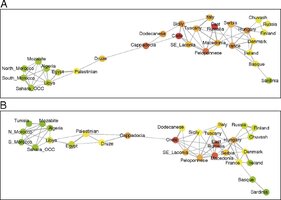
The Neolithic populations, which colonized Europe approximately 9,000 y ago, presumably migrated from Near East to Anatolia and from there to Central Europe through Thrace and the Balkans. An alternative route would have been island hopping across the Southern European coast. To test this hypothesis, we analyzed genome-wide DNA polymorphisms on populations bordering the Mediterranean coast and from Anatolia and mainland Europe. We observe a striking structure correlating genes with geography around the Mediterranean Sea with characteristic east to west clines of gene flow. Using population network analysis, we also find that the gene flow from Anatolia to Europe was through Dodecanese, Crete, and the Southern European coast, compatible with the hypothesis that a maritime coastal route was mainly used for the migration of Neolithic farmers to Europe.
PNAS
Proceedings of the National Academy of Sciences (PNAS), a peer reviewed journal of the National Academy of Sciences (NAS) - an authoritative source of high-impact, original research that broadly spans the biological, physical, and social sciences.
On PCA charts, although they are noticeably drifted from other Europeans, they still fall within the general cluster for Europe:
(Jews plot intermediary due to mixing)
FST wise they also are closest to other Europeans:
They also plot closely to the ancient Latini Romans & Mycenaean-Minoan Greeks
They also were always considered as White historically:
View: https://x.com/cremieuxrecueil/status/1952523100882682239
As even Prof. Roediger himself recognizes, naturalization laws throughout this period specified that citizenship was open to “free white persons,” and no one ever argued that “Guineas” and “Bohunks” were unqualified. Other races were. In 1922, the Supreme Court ruled that Japanese could not naturalize because they were not white. The next year, a subcontinental Indian came before the court, claiming he was “Caucasian,” and therefore eligible. In earlier cases, the court had sought expert testimony from anthropologists as to who was white, but in the Thind case, the justices ruled that it was simple common sense not to consider Indians white. New immigrants from Europe were unfailingly admitted to citizenship.
The census bureau during this period counted new immigrants the same way. It classified the first generation and their children as “foreign-born white,” but counted the third generation simply as white. This reflected both scholarly and popular assumptions. As a 1932 study by Donald Young called American Minority People noted of the new immigrant, it was “dimly realized that in a few generations he will be absorbed into the total white population.” Young went on to say that the “white immigrant [is] patently handicapped by foreign language and tradition” but the “Negro now is looked on as more of a biological problem.”
The prominent sociologist Henry Pratt Fairchild (1880–1956), whom the author calls “racist” for his views of non-whites, took a haughty but different view of the southern or central European: “If he proves himself a man and . . . acquires wealth and cleans himself up — very well, we might receive him in a generation or two. But at present he is far beneath us and the burden of proof rests with him.” Unlettered aliens would have to prove they could become American, and as Prof. Roediger notes, even the Italians found that if they renounced their foreign habits they were accepted. By 1920, scholars were generally predicting that European ethnics would assimilate. They were making no such predictions about blacks.
How the White Ethnics Assimilated - American Renaissance
Race deniers get in a muddle again.
www.amren.com
When it comes to phenos/appearance, many do have distinct European ones such as Gracile Med, Dinaro-Med, Dinarid, West alpinid, Pontid or some other mix of it. Some do have a Pseudo look to MENAs or have MENA phenos such as Trans-Med or Armenid.All of this said, however, Ed Peterson's remarks contained more than a kernel of truth. In the end, Italians' many perceived racial inadequacies aside, they were still largely accepted as white by the widest variety of people and institutions—naturalization laws and courts, the U.S. census, race science, anti-immigrant racialisms, newspapers, unions, employers, neighbors, realtors, settlement houses, politicians, and political parties. This widespread acceptance was reflected most concretely in Italians' ability to naturalize as U.S. citizens, apply for certain jobs, live in certain neighborhoods, marry certain partners, and patronize certain movie theaters, restaurants, saloons, hospitals, summer camps, parks, beaches, and settlement houses. In so many of these situations, as Peterson and the Defender well recognized, one color line existed separating "whites" from the "colored races"—groups such as "Negroes," "Orientals," and sometimes "Mexicans." And from the moment they arrived in Chicago—and forever after—Italians were consistently and unambiguously placed on the side of the former. If Italians were racially undesirable in the eyes of many Americans, they were white just the same.
They were so securely white, in fact, that Italians themselves rarely had to aggressively assert the point. Indeed, not until World War II did many Italians identify openly and mobilize politically as white. After the early years of migration and settlement, when Italy remained merely an abstraction to many newcomers, their strongest allegiance was to the Italian race, not the white one. Indeed, one of the central concerns of this book is to understand how Italianita', as both a racial and national consciousness, came to occupy such a central part of many Italians' self-understandings. For much of the turn-of-the-century and interwar years, then, Italians were white on arrival not so much because of the way they viewed themselves, but because of the way others viewed and treated them.