Evenki
Recruit
★★
- Joined
- May 26, 2025
- Posts
- 121
There's no denying it. If you are even a little bit interested in linguistics this should be common knowledge.
I say "European" because not all people native to Europe are part of this group. What we would call "European" is made up of three major groups- Slavic, Italic, and Germanic. The European "branch", however, is part of the larger Indo-European family. The other main branch is Indo-Iranian, which is made up of Indo-Aryan(what we would today call "Indian") and Iranic.
So, from a lineage perspective, Germanics, Italics, and Slavics are the most closely related to each other, and the next closest group is North Indians and Iranians. Groups that might be considered European or adjacent to European, like North Africans, Arabs, Uralics, (Hungarians, Finnish), Hellenics(Greeks), and Turks, are less closely related to the European branch than Indians are. They are also certainly much closer to Europeans than they are to Sub-Saharan Africans, East Asians, Austronesians, etc.
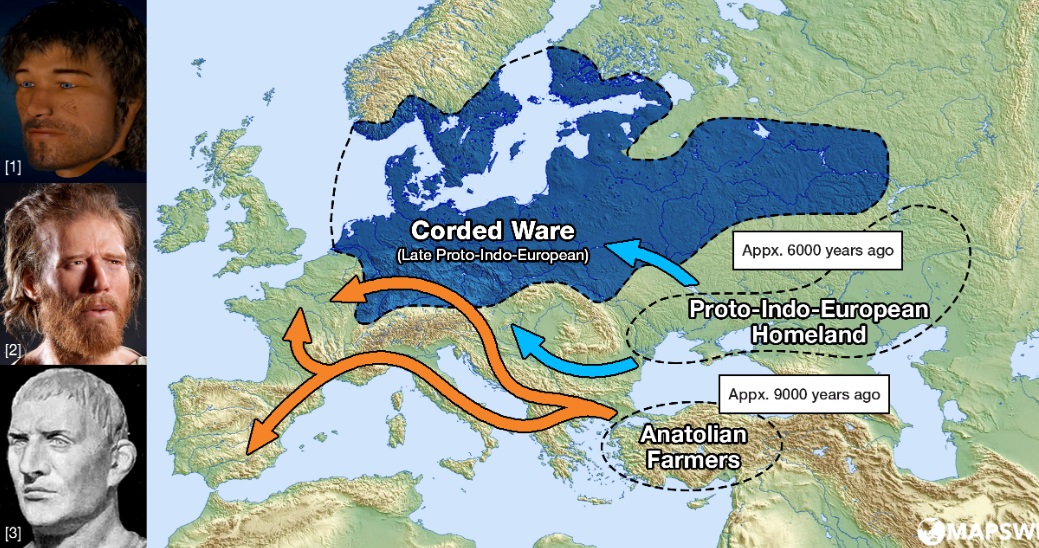
The "Aryan" race as people might call it originated somewhere around the Caucasus and split into two groups. The "European" branch migrated west and settled in Europe, and the Indo-Iranic branch migrated east into Persia and North India. What's interesting is that in India, regions have differing degrees of Indo-European admixture due to the caste system. Generally, South India has the most Dravidian(previous inhabitants of the Indian subcontinent) admixture, regions in North India like Punjab have the least. As you start going east from mainland India into Bengal, Myanmar, Thailand, Cambodia, etc., the people are now primarily a mix of Dravidian, Austronesian, and Sinitic(East Asian).
So before insulting Indians, you should know that "Europeans" and Indians are both from the Indo-European family.
I say "European" because not all people native to Europe are part of this group. What we would call "European" is made up of three major groups- Slavic, Italic, and Germanic. The European "branch", however, is part of the larger Indo-European family. The other main branch is Indo-Iranian, which is made up of Indo-Aryan(what we would today call "Indian") and Iranic.
So, from a lineage perspective, Germanics, Italics, and Slavics are the most closely related to each other, and the next closest group is North Indians and Iranians. Groups that might be considered European or adjacent to European, like North Africans, Arabs, Uralics, (Hungarians, Finnish), Hellenics(Greeks), and Turks, are less closely related to the European branch than Indians are. They are also certainly much closer to Europeans than they are to Sub-Saharan Africans, East Asians, Austronesians, etc.
The "Aryan" race as people might call it originated somewhere around the Caucasus and split into two groups. The "European" branch migrated west and settled in Europe, and the Indo-Iranic branch migrated east into Persia and North India. What's interesting is that in India, regions have differing degrees of Indo-European admixture due to the caste system. Generally, South India has the most Dravidian(previous inhabitants of the Indian subcontinent) admixture, regions in North India like Punjab have the least. As you start going east from mainland India into Bengal, Myanmar, Thailand, Cambodia, etc., the people are now primarily a mix of Dravidian, Austronesian, and Sinitic(East Asian).
So before insulting Indians, you should know that "Europeans" and Indians are both from the Indo-European family.