IncelCream
Paragon
★★★★★
- Joined
- Feb 4, 2020
- Posts
- 15,725



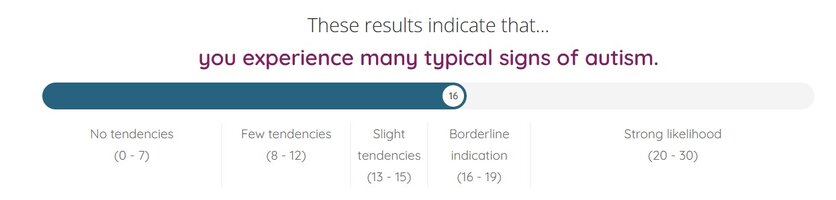
can you send the linkplezThis is result
can you send the linkplez
Nice i'm similar
Nice i'm similar
Same hahahahai do not think i am autistic, rather i have chronic long term inceldom disorder which makes me very socially inept


Unsurprising - I even downplayed some of my autistic traits. I refuse to get an official diagnosis until I need NEETbux. At least I can wear the hat with pride.
View attachment 811729
View attachment 811730

In 2003, we proposed the hypersystemizing theory of autism. The theory proposes that the human mind possesses a systemizing mechanism (SM) that helps identify lawful regularities (often causal) that govern the input-operation-output workings of a system. The SM can be tuned to different levels, from low to high, with a normal distribution of individual differences in how strongly people search for such input-operation-out-put regularities in any data that is systemizable. Evidence suggests that people with autism are on average hypersystemizers, scoring higher than average on the systemizing quotient and on performance tests of systemizing. In this article, we consider the neural basis behind the SM, since there has been little consideration of the brain basis of systemizing. Finally, we discuss directions for future work in this field.
Processing information and learning that may not lead to disability, but may be an example of “neurodiversity” and result in talent.6,7 A subset of individuals with autism show savantism—abilities restricted to specific domains that are both superior to the individual's other skills and superior to the majority of the population. In this article, we discuss the “hypersystemizing” theory of autism as a potential explanation between the link between autism and talent. First proposed in 2003 ,8 this theory posits that in autism, the systemizing mechanism (SM) is tuned to above-average levels. The SM processes information in a highly specific form: input-operation-output relations. Here, we extend this theory by examining the possible brain basis underlying component processes in the SM and discuss future directions and predictions made by the theory.

Nice based
I only really relate to the social aspect.Nice based

Intelligence in the normal range is a polygenic trait, meaning that it is influenced by more than one gene, and in the case of intelligence at least 500 genes. Further, explaining the similarity in IQ of closely related persons requires careful study because environmental factors may be correlated with genetic factors.
| 1000Genomes_30x | Global | Study-wide | 6404 | C=0.8612 | A=0.1388 |
| 1000Genomes_30x | African | Sub | 1786 | C=0.8914 | A=0.1086 |
| 1000Genomes_30x | Europe | Sub | 1266 | C=0.8420 | A=0.1580 |
| 1000Genomes_30x | South Asian | Sub | 1202 | C=0.9210 | A=0.0790 |
| 1000Genomes_30x | East Asian | Sub | 1170 | C=0.8282 | A=0.1718 |
| 1000Genomes_30x | American | Sub | 980 | C=0.797 | A=0.203 |
| 1000Genomes_30x | Global | Study-wide | 6404 | G=0.7313 | T=0.2687 |
| 1000Genomes_30x | African | Sub | 1786 | G=0.8303 | T=0.1697 |
| 1000Genomes_30x | Europe | Sub | 1266 | G=0.8104 | T=0.1896 |
| 1000Genomes_30x | South Asian | Sub | 1202 | G=0.7180 | T=0.2820 |
| 1000Genomes_30x | East Asian | Sub | 1170 | G=0.4265 | T=0.5735 |
| 1000Genomes_30x | American | Sub | 980 | G=0.829 | T=0.171 |