The Notorious SLAV
Foid Oppression Denial Division Commander
★★★★★
- Joined
- Oct 30, 2022
- Posts
- 21,682
- Online time
- 3d 12h
Truly a show of how much muh oppression women faced in the past , at least in some countries. This totally convinced me how needed feminism and all of its multiple waves and countless amounts of misandric publications were.
Props to @GeckoBus for finding this on a now-inactive MRA site:

 nomoremisandry.blogspot.com
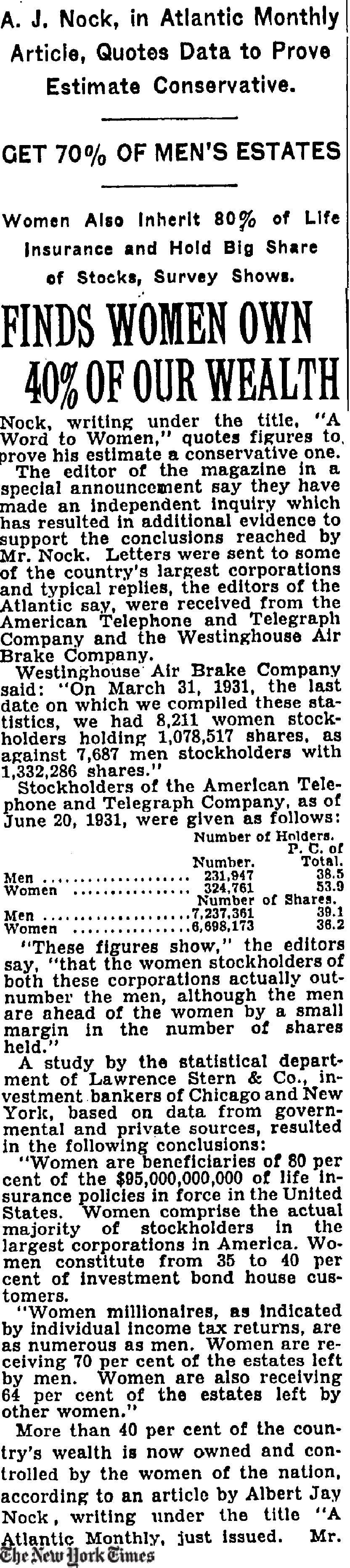
Them claiming all of that while saying that it's a "conservative estimate" is a cherry on top of that.
In case anyone doubts it, it's a real article and you can see it at NY Times's archive:
You can only read it if you have their subscription or whatever it is that they demand, but from the structure of the article they show, it seems that the one on that MRA site is indeed the entirety of it.
Though, since that article itself was written as a response to another one, I decided to look for that one. You can find the entirety of it for free on The Atlantic's website, and it's quite a doozy:
 www.theatlantic.com
We get all the important statistics at the very beginning, along with clarification that it was something the writer had read a few years ago, making it an almost century-old piece of information at this point:
After that, it turns into long musings about how uniquely free American women are compared to European ones (doing the basic "women here have it good, but trust me, they have it so bad abroad" stuff) and how fascinated Europeans are by American women because of that.
That is interwoven with the author's thoughts on feminism, saying that they should be more thoughtful and reasonable, and that, really, feminism is just for poor women, because rich women have always done whatever they wanted anyway:
An interesting read ngl.
, at least in some countries. This totally convinced me how needed feminism and all of its multiple waves and countless amounts of misandric publications were.Props to @GeckoBus for finding this on a now-inactive MRA site:
In 1931 There Were Just as Many Female Millionaires as Men
In 1931 there were just as many female millionaires as men despite women having a labor force participation rate of under 40% back then wo...
nomoremisandry.blogspot.com
In 1931 there were just as many female millionaires as men despite women having a labor force participation rate of under 40% back then women held 40% of the nations wealth, comprised the majority of stockholders in the largest corporations in America and comprised 35 to 40 percent of investment bond customers.
This is at the time when according to the feminist liars out here men were all greedily taking the money for themselves and oppressing women at the bottom. Ask yourself the following question. What other systematically "oppressed" group of people throughout history have had the same number of millionaires as their supposed oppressors, owned 40% of the nation's wealth and inherited 70% of their supposed masters wealth?
Them claiming all of that while saying that it's a "conservative estimate" is a cherry on top of that.
In case anyone doubts it, it's a real article and you can see it at NY Times's archive:
You can only read it if you have their subscription or whatever it is that they demand, but from the structure of the article they show, it seems that the one on that MRA site is indeed the entirety of it.
Though, since that article itself was written as a response to another one, I decided to look for that one. You can find the entirety of it for free on The Atlantic's website, and it's quite a doozy
:A Word to Women
The Atlantic covers news, politics, culture, technology, health, and more, through its articles, podcasts, videos, and flagship magazine.
We get all the important statistics at the very beginning, along with clarification that it was something the writer had read a few years ago, making it an almost century-old piece of information at this point:
A LONG time ago — all of three years, perhaps longer — I saw , a floating item in a periodical to the effect that 41 per cent of our national wealth is controlled by women, and that the percentage is rising. Curiously, this bit of news did not make much of an impression on me at the time, but the recollection of it kept coming back to me afterward, and more frequently as time went on.
It appears that a firm of investment bankers operating in Chicago and New York had made an investigation into the division of our national wealth between the sexes... The general conclusion was that at the time the survey was made, say four years ago, nearly half our national wealth was controlled by women, and that the proportion was tending to increase steadily and rather rapidly.
Some of the incidental findings turned up by the investigation are interesting. It found that ninety-five billion dollars’ worth of life-insurance policies were in force in this country, and that 80 per cent of their beneficiaries were women... It found that women were taxed on three and a quarter billion dollars of income annually; men, on four and three quarters. One hundred and thirty-nine women paid taxes on incomes in excess of a half million, as against one hundred and twenty-three men; while forty-four women paid on net incomes in excess of a million, as against forty-two men. Women were found to be majority or almost majority shareholders in some of our largest corporations, for instance the Pennsylvania Railway, American Telephone and Telegraph, United States Steel, Westinghouse Air Brake, and National Biscuit Company.
After that, it turns into long musings about how uniquely free American women are compared to European ones (doing the basic "women here have it good, but trust me, they have it so bad abroad" stuff) and how fascinated Europeans are by American women because of that.
One sees Europeans regarding casual specimens of our petticoated produce, more often than not pretty poor specimens, and wondering what on earth they have in them to have worked themselves into their highly privileged status, and to have got this status accepted without objection or complaint. The European would say that such a notable collective manœuvre betokens first-rate ability somewhere, and he cannot see that they have it; his own womenfolk, by and large, seem much abler, wiser, more mature of mind. Cleverness will not answer; he acknowledges that American women are very clever, but no one can be that clever. Nor can such a piece of strategy be put through nation-wide on the strength of feminine fascinations, even granting that American women are endowed with these beyond all other women, which he thinks highly doubtful.
That is interwoven with the author's thoughts on feminism, saying that they should be more thoughtful and reasonable, and that, really, feminism is just for poor women, because rich women have always done whatever they wanted anyway:
At any period in history, I think, one may find women ‘living their own lives’ in the feminists’ sense, about as satisfactorily as men were living theirs; doing, if they chose, just what men did, and doing it just about as well. One must observe, however, that these women were relatively few, they were always exceptional, and — here is, I think, the important thing — they were all marked by one sole invariable differentiation: they were economically independent.
It may therefore be said, I think, that the efforts of feminism have never been, strictly speaking, in behalf of the rights of women, but in behalf of the rights of poor women; and all the greater honor to feminism that this is so! Those who were not poor or dependent seem always to have been able pretty well to do as they liked with themselves, and, as our expressive slang goes, ‘to get away with it.’
An interesting read ngl
.