The Notorious SLAV
Foid Oppression Denial Division Commander
★★★★★
- Joined
- Oct 30, 2022
- Posts
- 21,682
- Online time
- 3d 12h
Emphasis on the might there, but this is interesting .
.

 pubmed.ncbi.nlm.nih.gov
Some obvious stuff first:
But apart from that, this study included something I don't think I've ever seen before, a graph where they measured kids' self-perceived popularity, using both their grade 3 and grade 9 looks at the same time:
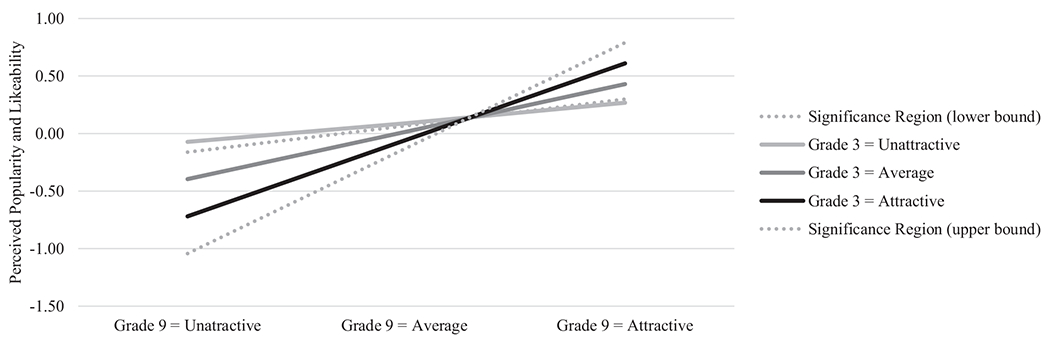
The paper talks a lot about how high the self-perceived popularity is for people who were considered attractive in grade 3 and still are considered attractive, but it's the other half of it that's most interesting to me. For grade 9 unattractives, their self-perceived popularity was inversely proportional to where they were at grade 3. For people who were considered unattractive in both instances, it barely mattered, they were just on their normal level, while average normies who fell down and turned unattractive during puberty considered themselves notably less popular, and those who become puberty were attractive just completely fell down and basically considered themselves to be complete outcasts.
I wonder what's the reason for that; what mechanism is at play here. It could be, and that's what I think, that the more popular you are, the more it stings when you lose that popularity and the more you know and feel just how much you've lost. Or, maybe, there's a "personality" answer, and the guys who once were normies and Chads got used to acting in the way normies and Chads can, but ugly incels can't, and so when they try to still act in the way they once could and like they weren't ugly, they get shot down and humiliated socially, and that makes them feel like they are maybe even more unpopular than they truly are, and makes them feel their new unpopularity.
The graph is just about self-perceived popularity and looks, but the paper makes it clear that the same relationship holds for looks and dating/sexual experiences:
And let's be real, there's no "personality" explanation possible here, since the baseline ninth grader has a shit personality even compared to people in their late teens.
.
The Developmental Significance of Looks from Middle Childhood to Early Adolescence - PubMed
Physical appearance during the transition into adolescence matters for youths' socioemotional development. This study explored these implications by adding visual data to the NICHD Study of Early Child Care and Youth Development (n = 1,049) to test how others' ratings of youths' looks (1 = very...
pubmed.ncbi.nlm.nih.gov
Some obvious stuff first:
Results revealed recency effects of grade 9 looks on popularity/likability and dating/sexual behaviors and a lingering amplification effect of grade 3 looks on popularity/likability at the start of high school. Few associations were evident for emotional well-being.
A one standard deviation unit increase in ninth-grade looks was associated with over a fourth of a standard deviation increase in perceived popularity/likability (Model 3 in Table 3; b = .283, b SE = .047, p < .001) and over a third of a standard deviation increase in progression along the dating/sex continuum (Model 3 of Table 4; b = .339, SE = .061, p < .001), even after accounting for grade 3 looks.
Looks had a serious effect on popularity and dating/sexual experience, and very little on emotional well-being. That doesn't necessarily mean that popularity and sexual experience themselves had no correlation with emotional well-being, but it does at least imply that. To no one's surprise, the jocks and sluts who rule the roost at their schools and are getting laid daily while incel nerds try to not be noticed while returning home alone aren't at their position because they daily read self-help books and go through mental health courses to deal with all the issues that bluepillers tell us we must deal with before we even think of trying to find a partner, and in fact, nobody does that, you can be a normal human being with normal human problems and insecurities and as long as you are decently attractive, friends, status and sex will be just given to you for free. Simple as that, we all know that.Although results from this study hint at recency effects of contemporaneous looks on grade 9 emotional well-being, this finding is only marginally significant. One potential explanation is that appearance is only one component that contributes to emotional well-being. Youth have many other positive traits that may balance out the effects of being unattractive (e.g., humor, athleticism, intelligence) on emotional well-being (Becker & Luthar,2007; Markovic & Bowker, 2015).
But apart from that, this study included something I don't think I've ever seen before, a graph where they measured kids' self-perceived popularity, using both their grade 3 and grade 9 looks at the same time:
The paper talks a lot about how high the self-perceived popularity is for people who were considered attractive in grade 3 and still are considered attractive, but it's the other half of it that's most interesting to me. For grade 9 unattractives, their self-perceived popularity was inversely proportional to where they were at grade 3. For people who were considered unattractive in both instances, it barely mattered, they were just on their normal level, while average normies who fell down and turned unattractive during puberty considered themselves notably less popular, and those who become puberty were attractive just completely fell down and basically considered themselves to be complete outcasts
.I wonder what's the reason for that; what mechanism is at play here. It could be, and that's what I think, that the more popular you are, the more it stings when you lose that popularity and the more you know and feel just how much you've lost
. Or, maybe, there's a "personality" answer, and the guys who once were normies and Chads got used to acting in the way normies and Chads can, but ugly incels can't, and so when they try to still act in the way they once could and like they weren't ugly, they get shot down and humiliated socially, and that makes them feel like they are maybe even more unpopular than they truly are, and makes them feel their new unpopularity.The graph is just about self-perceived popularity and looks, but the paper makes it clear that the same relationship holds for looks and dating/sexual experiences:
Your previous looks only "matter" in the sense of people generally retaining their looks and so grade 3 looks were still able to predict those types of experiences, but in grade 9, only the teens' current looks truly mattered, and those who were ugly in grade 3 were getting laid just as much as those who were attractive since childhood, while those who were attractive in grade 3 but fell off were not getting laid just as much as those who were ugly the entire time. And they were probably more salty about it if the graph above is any indication.This lingering effect was not evident for progression along the dating/sex continuum. Although grade 3 looks significantly predicted dating and sexual behavior when considered on their own (Model 1), these associations fell to nonsignificance when grade 9 looks were added (Model 3), and the interaction was nonsignificant (Model 4). The small increase in the standard error for grade 3 looks from Model 1 to Model 3 (b SE = .058 vs. .060) reflected minimal collinearity (VIF for grade 3looks = 1.50 in Model 3). Thus, the decrease of the effect from Model 1 to Model 3 suggests that grade 9 looks captured bids for dating/sex for those who had been good looking in elementary school and were still attractive at high school entry and for new high school entrants who had been less attractive in grade 3 but were attractive by grade 9.
And let's be real, there's no "personality" explanation possible here, since the baseline ninth grader has a shit personality even compared to people in their late teens.