Anarcho Nihilist
Generalfeldmarschall
★★★★★
- Joined
- Jul 12, 2024
- Posts
- 6,310
- Online time
- 7h 54m
He wrote many times about the amazement of the Western intelligentsia with Maoism in the 1960s and 70s (later systemic "Green Parties" and what we call "left-liberals" came out of them, although their more strict designation is anarchists). And now I met another wonderful example on this topic:
"In the late 60s, those who doubted psychiatry at all - the psychiatrists themselves - raised their heads in the wake of Maoism. They began to prove that there were no problems associated with any diseases of the human brain, and in general this is all fiction. The extreme option is Dr. D. Leng, a very popular one at one time in our country. In the early 2000s, there were many editions of his book. He, along with a group of his supporters and the sick, took over a mental hospital in England. They threw out all the medicines, and the whole treatment boiled down to reading aloud the quotation book of Mao Zedong."
(Head of the Department of Medical Psychology of the Scientific Center for Mental Health Sergey Enikolopov - 129th meeting of the Moscow Club of the Moscow Exchange, March 2024)
It turns out that under the influence of Western Maoists, various sexual perversions were excluded from the list of mental illnesses, and in general the system came to the conclusion that mental illnesses almost do not exist, but there are "character traits." But in the 1990s, a powerful rollback from these views began: it began to be believed that healthy people do not exist and almost all patients in childhood received at least psychotraumas (mainly from their parents). This was done under the influence of lobbying companies to get millions of people hooked on antidepressants and other "psychotropic" pills. In addition, a huge class of psychotherapists has appeared - a multibillion-dollar business.
Rosenhan Experiment - Wikipedia
en.wikipedia.org›Rosenhan experiment
One of the experiments of Western Maoists in the 1960s and 1970s was to convince people that the mentally ill almost did not exist. Enikolopov talks about this experiment:
"The key here was the experiment of Professor Rosenhan [an American psychologist], conducted in 1971. He and seven of his colleagues, who first underwent various psychological tests with several psychiatrists and made sure that everything was fine with them, then turned to different clinics with a single complaint that they allegedly had voices in their heads ("empty," "deaf," "illegible"), and did not complain about anything else." In twelve clinics, seven patients were diagnosed with schizophrenia, one with manic-depressive psychosis, and the rest with what I liked: "sound hallucinations reflecting the subjects' painful concern about the meaninglessness of life." They were discharged, giving them 2,100 pills each, and kept in hospitals for 7 to 52 days. In the hospital, they behaved calmly, in accordance with the conditions of the experiment.
Interestingly, not a single person from the staff - neither nurses, nor guards who work in a psychiatric hospital and have a planned eye, nor doctors - neither of them doubted who was in front of them. All of them were discharged with a diagnosis of temporary improvement.
I liked the second part of the experiment even more. When all this was published, the American Psychiatric Association in California, where all this happened, was outraged, calling the publication slander, lies and so on. Rosenhan and his comrades said they would continue the experiment and send even more volunteers. They even announced the start date of the experiment. But no one was sent, but simply looked at what diagnoses were made to really sick people who independently sought help. Of the 193 patients, 41 were recognized as simulators. This experiment for a time significantly undermined the influence of the American Psychiatric Association, which was actively involved in the development of the so-called DSM.
Recently they wrote that the hierarchy under the Maoist regime of Pol Pot was determined by the number of ballpoint pens in the pocket. Pens were FORBIDDEN to peasants and representatives of other lower classes. Pol Pot had 3 ballpoint pens in his pocket. It would seem that there is nowhere higher. But no, perhaps Khieu Samphan ("brother No. 5") had 4 ballpoint pens - he was responsible in the Ministry of Foreign Affairs for receiving the bohemian western left Maoists. Western Maoists came to Kampuchea and wrote how good everything was there, and if there were victims of the revolution, they were killed by the Vatican and the CIA. This Khieu Samphan, of course, studied in France and received his doctorate in economics there. Together with Paul Pot, when they came to power in 1975, they issued the first two decrees: 1) Kill everyone who wears glasses. 2) Ban money.
(Under Pol Pot, 15,000 bespectacled men were killed in the first three days of the victorious revolution. Maoism in Kampuchea was reduced to extreme radicalism. Safan wrote: "We need to suppress the intelligentsia's desire for a Western way of life - including books and glasses. Intelligentsia as such should not be at all. Its representatives will engage in social labor, live with peasants and learn from them.")
But this radicalism rather arose under the influence of the French bohemian society in which this top manager revolved in his youth.
It was in France that Samphan met Pol Pot, Ieng Sari, Hu Nim and other future Khmer Rouge leaders. Later, Khieu Samphan's two sisters became the wives of Pol Pot and Ieng Sari.
Here's how the European Maoists' collaboration with Pol Pot's regime is briefly described:
"In October 1976, under the influence of the Maoist Communist Party of Sweden, the Swedish-Kampuchean Friendship Association was founded. In Denmark, it was the "Kampuchean Committee" created by the Communist Workers' Party (Maoist). " The first organization to begin cooperation under the new regime was the Norwegian-Cambodian Friendship Association, founded in the spring of 1975 by local Maoists and Khojists (supporters of the Enver Hoxha regime in Albania - approx. T.).
A Swedish delegation led by Bergstrom went to Kampuchea in August 1978. The group included Edda Eckerwald, writer Jan Myrdal and Marita Vikander. The delegation traveled all over the country, visiting hospitals, schools and labor communes. Throughout the route, they were accompanied by representatives of the Khmer Rouge.
The members of the delegation shared Pol Pot's ideas about turning Kampuchea into a socialist state of workers, even more progressive than China, especially since by 1978 the Chinese revisionists began to depart from the ideas of Mao Zedong.
He began reading biographies of Swedish Maoists and immediately understood which family the famous writer Gunnar Myrdal came from: "Born in Stockholm in the family of future Nobel laureates, Social Democrats Gunnar Myrdal and Alva Myrdal. Father is a Nobel laureate in economics, mother is a Nobel Peace Prize laureate.'

(to previous post)
Murdal did not abandon Maoism until the end of his life in 2020. True, in the 1990s he still joined the fight against "climate change" (bequeathed part of the inheritance to these fighters), and in the same years he also became a fan of the Ayatollah regime in Iran. Plus, like all Maoists, he not only preserved, but even intensified zoological hatred of the USSR.
Read by Murdal's obituary of European Maoists:
"I remember with what anger the Brezhnev propagandist from Poland Veslav Gurnitsky wrote about him, who drove into Phnom Penh in the convoy of the Vietnamese invaders, in his book Hourglass. And it is not at all surprising that after a few years these people gladly surrendered their country to the bourgeois "Solidarity"!
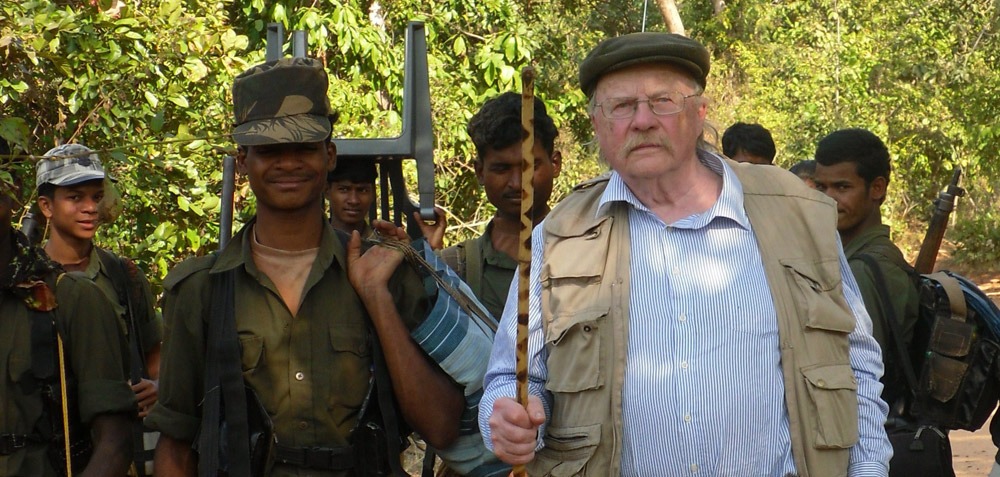
Jan Myrdal remained faithful to his beliefs until the end of his life! Myrdal unconditionally supported the real revolutionaries: Mao Zedong, Enver Hoju, the Communist Party of Kampuchea, the Indian Naxalites. Being already a completely elderly person (at 83!) In 2010, he went to India to areas controlled by Indian Naxalite partisans - supporters of the ideas of Mao Zedong - and wrote a book about this "Red Star over India. Reflections when the damned lands rise." After the release of this book (it was published in 2011) in 2012, capital puppets from the Indian government banned Muirdal from entering India in the future.
And here's how Myrdal felt about Muslim revolutionaries: "In another message published in Dagens Nyheter on December 8, 1992, Myrdal wrote:" I respect the Islamic revolution in Iran. This is due to the fact... that the Islamic revolution of our time, when the communist masses undermined by the Kremlin disintegrated, for the peoples of most of the world actually represents the only politically organized hope for a decent life.
Top photo shows Jan Myrdal, Marita Vikander, Gunnar Bergström and Hedda Ekerwald against the backdrop of the Angkor Wat temple in Khmer Rouge Democratic Kampuchea in August 1978."
(In general, it is clearly visible on what basis the so-called "left-liberalism" sprouted in Europe)
"In the late 60s, those who doubted psychiatry at all - the psychiatrists themselves - raised their heads in the wake of Maoism. They began to prove that there were no problems associated with any diseases of the human brain, and in general this is all fiction. The extreme option is Dr. D. Leng, a very popular one at one time in our country. In the early 2000s, there were many editions of his book. He, along with a group of his supporters and the sick, took over a mental hospital in England. They threw out all the medicines, and the whole treatment boiled down to reading aloud the quotation book of Mao Zedong."
(Head of the Department of Medical Psychology of the Scientific Center for Mental Health Sergey Enikolopov - 129th meeting of the Moscow Club of the Moscow Exchange, March 2024)
It turns out that under the influence of Western Maoists, various sexual perversions were excluded from the list of mental illnesses, and in general the system came to the conclusion that mental illnesses almost do not exist, but there are "character traits." But in the 1990s, a powerful rollback from these views began: it began to be believed that healthy people do not exist and almost all patients in childhood received at least psychotraumas (mainly from their parents). This was done under the influence of lobbying companies to get millions of people hooked on antidepressants and other "psychotropic" pills. In addition, a huge class of psychotherapists has appeared - a multibillion-dollar business.
Rosenhan Experiment - Wikipedia
en.wikipedia.org›Rosenhan experiment
One of the experiments of Western Maoists in the 1960s and 1970s was to convince people that the mentally ill almost did not exist. Enikolopov talks about this experiment:
"The key here was the experiment of Professor Rosenhan [an American psychologist], conducted in 1971. He and seven of his colleagues, who first underwent various psychological tests with several psychiatrists and made sure that everything was fine with them, then turned to different clinics with a single complaint that they allegedly had voices in their heads ("empty," "deaf," "illegible"), and did not complain about anything else." In twelve clinics, seven patients were diagnosed with schizophrenia, one with manic-depressive psychosis, and the rest with what I liked: "sound hallucinations reflecting the subjects' painful concern about the meaninglessness of life." They were discharged, giving them 2,100 pills each, and kept in hospitals for 7 to 52 days. In the hospital, they behaved calmly, in accordance with the conditions of the experiment.
Interestingly, not a single person from the staff - neither nurses, nor guards who work in a psychiatric hospital and have a planned eye, nor doctors - neither of them doubted who was in front of them. All of them were discharged with a diagnosis of temporary improvement.
I liked the second part of the experiment even more. When all this was published, the American Psychiatric Association in California, where all this happened, was outraged, calling the publication slander, lies and so on. Rosenhan and his comrades said they would continue the experiment and send even more volunteers. They even announced the start date of the experiment. But no one was sent, but simply looked at what diagnoses were made to really sick people who independently sought help. Of the 193 patients, 41 were recognized as simulators. This experiment for a time significantly undermined the influence of the American Psychiatric Association, which was actively involved in the development of the so-called DSM.
Recently they wrote that the hierarchy under the Maoist regime of Pol Pot was determined by the number of ballpoint pens in the pocket. Pens were FORBIDDEN to peasants and representatives of other lower classes. Pol Pot had 3 ballpoint pens in his pocket. It would seem that there is nowhere higher. But no, perhaps Khieu Samphan ("brother No. 5") had 4 ballpoint pens - he was responsible in the Ministry of Foreign Affairs for receiving the bohemian western left Maoists. Western Maoists came to Kampuchea and wrote how good everything was there, and if there were victims of the revolution, they were killed by the Vatican and the CIA. This Khieu Samphan, of course, studied in France and received his doctorate in economics there. Together with Paul Pot, when they came to power in 1975, they issued the first two decrees: 1) Kill everyone who wears glasses. 2) Ban money.
(Under Pol Pot, 15,000 bespectacled men were killed in the first three days of the victorious revolution. Maoism in Kampuchea was reduced to extreme radicalism. Safan wrote: "We need to suppress the intelligentsia's desire for a Western way of life - including books and glasses. Intelligentsia as such should not be at all. Its representatives will engage in social labor, live with peasants and learn from them.")
But this radicalism rather arose under the influence of the French bohemian society in which this top manager revolved in his youth.
It was in France that Samphan met Pol Pot, Ieng Sari, Hu Nim and other future Khmer Rouge leaders. Later, Khieu Samphan's two sisters became the wives of Pol Pot and Ieng Sari.
Here's how the European Maoists' collaboration with Pol Pot's regime is briefly described:
"In October 1976, under the influence of the Maoist Communist Party of Sweden, the Swedish-Kampuchean Friendship Association was founded. In Denmark, it was the "Kampuchean Committee" created by the Communist Workers' Party (Maoist). " The first organization to begin cooperation under the new regime was the Norwegian-Cambodian Friendship Association, founded in the spring of 1975 by local Maoists and Khojists (supporters of the Enver Hoxha regime in Albania - approx. T.).
A Swedish delegation led by Bergstrom went to Kampuchea in August 1978. The group included Edda Eckerwald, writer Jan Myrdal and Marita Vikander. The delegation traveled all over the country, visiting hospitals, schools and labor communes. Throughout the route, they were accompanied by representatives of the Khmer Rouge.
The members of the delegation shared Pol Pot's ideas about turning Kampuchea into a socialist state of workers, even more progressive than China, especially since by 1978 the Chinese revisionists began to depart from the ideas of Mao Zedong.
He began reading biographies of Swedish Maoists and immediately understood which family the famous writer Gunnar Myrdal came from: "Born in Stockholm in the family of future Nobel laureates, Social Democrats Gunnar Myrdal and Alva Myrdal. Father is a Nobel laureate in economics, mother is a Nobel Peace Prize laureate.'
(to previous post)
Murdal did not abandon Maoism until the end of his life in 2020. True, in the 1990s he still joined the fight against "climate change" (bequeathed part of the inheritance to these fighters), and in the same years he also became a fan of the Ayatollah regime in Iran. Plus, like all Maoists, he not only preserved, but even intensified zoological hatred of the USSR.
Read by Murdal's obituary of European Maoists:
"I remember with what anger the Brezhnev propagandist from Poland Veslav Gurnitsky wrote about him, who drove into Phnom Penh in the convoy of the Vietnamese invaders, in his book Hourglass. And it is not at all surprising that after a few years these people gladly surrendered their country to the bourgeois "Solidarity"!
Jan Myrdal remained faithful to his beliefs until the end of his life! Myrdal unconditionally supported the real revolutionaries: Mao Zedong, Enver Hoju, the Communist Party of Kampuchea, the Indian Naxalites. Being already a completely elderly person (at 83!) In 2010, he went to India to areas controlled by Indian Naxalite partisans - supporters of the ideas of Mao Zedong - and wrote a book about this "Red Star over India. Reflections when the damned lands rise." After the release of this book (it was published in 2011) in 2012, capital puppets from the Indian government banned Muirdal from entering India in the future.
And here's how Myrdal felt about Muslim revolutionaries: "In another message published in Dagens Nyheter on December 8, 1992, Myrdal wrote:" I respect the Islamic revolution in Iran. This is due to the fact... that the Islamic revolution of our time, when the communist masses undermined by the Kremlin disintegrated, for the peoples of most of the world actually represents the only politically organized hope for a decent life.
Top photo shows Jan Myrdal, Marita Vikander, Gunnar Bergström and Hedda Ekerwald against the backdrop of the Angkor Wat temple in Khmer Rouge Democratic Kampuchea in August 1978."
(In general, it is clearly visible on what basis the so-called "left-liberalism" sprouted in Europe)
Last edited: