Shark
worthless lowlife untermensch scum
★★★★★
- Joined
- Apr 6, 2024
- Posts
- 26,514
- Online time
- 10d 7h
Do you believe some kind of God exists and if so how do you define him?


Same way I don't believe in Adam and Eve, but use those terms to describe hypothetical proto-humans. A hypothetical Adam, would've been perfect, he would posses true human nature, any descendant of Adam would, through nurture, stray further and further from Adam's nature, the true human nature.I use the term God to describe a hypothetical blueprint for all life. He is the macrocosm, and everything else is the microcosm.
All life is born, all life grows, then all life dies. But why do things work that way? Why isn't all life eternal? Why does it need to grow, aren't we vulnerable in our infancy?
Supposedly the universe came from nothing, and is expanding/growing - same pattern.
In my mind, if there is a God, he would've been the first thing to be born, is currently growing and will one day die. He's an abstract form of life that we have all inherited. "We are made in his image" so to say.
This idea of God isn't necessarily a living being with an ego, just an occurrence, a phenomenon.
No proof ofc and this god wouldn't be moralist, but purely ontological.
But how do you explain what or who created this nature in the first place? Something cannot come from nothing.Atheist because human nature is basically the opposite of God's image. We are animals that gained conscience.

My best way of describing him is simple: He Is.
Then God Himself must come from something.Something cannot come from nothing.

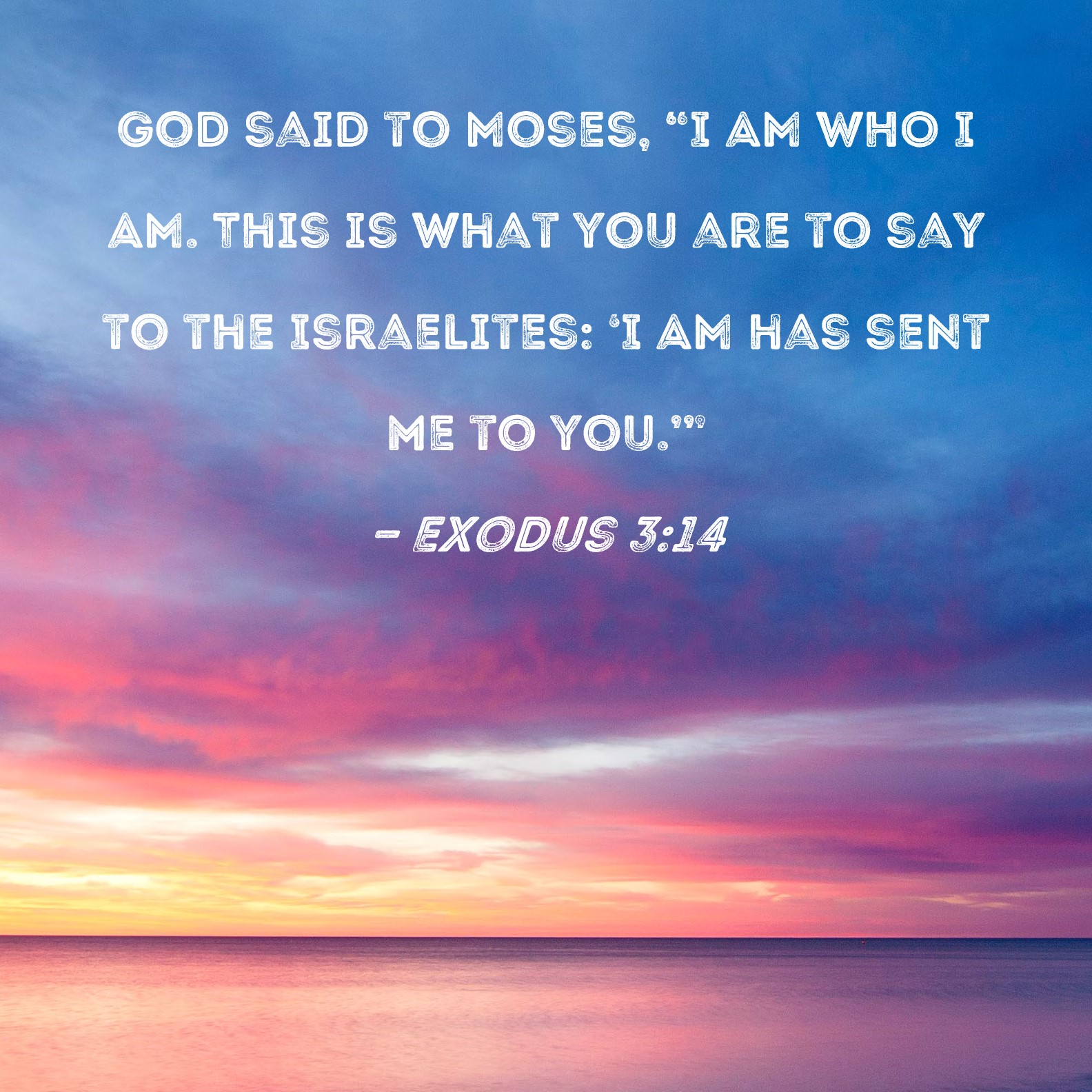
That's why I say the Abrahamic faith is the closest Assimilation to the God I propose as an Idea.Exodus 3:14 - Moses at the Burning Bush
God said to Moses, I AM WHO I AM. This is what you are to say to the Israelites: 'I AM has sent me to you.'biblehub.com

God of confusion.Hence why the Abrahamic faith is so wide spread, and relatively logically sound.
Agreeable that he's not consistent all the time. hence only an assimilation to what I would name the "true" God.God of confusion.
He's not even logical at all, his behavior is more of a petulant parent who throws tantrums over his supposed "creations" not following the strictest of rules. He wishes misfortune and death over any strayers, topping it off with an eternity in burning hellfire.
Slam dunk Judaism, Christianity, Catholicism, and Islamic faith in the trash.

Yes but no specific oneDo you believe some kind of God exists and if so how do you define him?


Yes, I am God.Do you believe some kind of God exists and if so how do you define him?

Good take. I would however disagree with the assumption that even God will die one day. "God" is the precondition for anything to occur at all. Without "God", there is no "death" at all. God, as I see it, is the existential labyrinth where the entirety of physics plays out.I use the term God to describe a hypothetical blueprint for all life. He is the macrocosm, and everything else is the microcosm.
All life is born, all life grows, then all life dies. But why do things work that way? Why isn't all life eternal? Why does it need to grow, aren't we vulnerable in our infancy?
Supposedly the universe came from nothing, and is expanding/growing - same pattern.
In my mind, if there is a God, he would've been the first thing to be born, is currently growing and will one day die. He's an abstract form of life that we have all inherited. "We are made in his image" so to say.
This idea of God isn't necessarily a living being with an ego, just an occurrence, a phenomenon.
No proof ofc and this god wouldn't be moralist, but purely ontological.
I would add that I still identify as an atheist for the most part since I neither equate divinity with moral goodness nor believe that "God" has a will of its own. It's rather that everything which exists is just varying mutations of what I would call God.Good take. I would however disagree with the assumption that even God will die one day. "God" is the precondition for anything to occur at all. Without "God", there is no "death" at all. God, as I see it, is the existential labyrinth where the entirety of physics plays out.


I believe he has to die since we also die. We just can't comprehend his lifespan. We haven't witnessed his birth and won't witness his death. What was born after him must die before him.Good take. I would however disagree with the assumption that even God will die one day. "God" is the precondition for anything to occur at all. Without "God", there is no "death" at all. God, as I see it, is the existential labyrinth where the entirety of physics plays out.
Well if we can't comprehend its "lifespan", surely it wouldn't be appropriate to apply our conceptions of "birth" and "death" to it right? In any case, I don't think any kind of interpretation pertaining to the "lifespan" of God is legitimate since God itself is the precondition which makes "before" and "after" conceivable. God is beyond time, time itself can't arise without God. Any statement about God's "death" does not make sense since God is not some agent in space-time. It is the necessary common essence of all existence. Insofar as anything can be said to "exist", it is within God. God is the condition that makes existence, change, birth, decay, and continuity possible in the first place. In that sense he is not a person or entity but rather it is the field within which all determinate things arise and vanish.I believe he has to die since we also die. We just can't comprehend his lifespan. We haven't witnessed his birth and won't witness his death. What was born after him must die before him.
God is not "eternal" in the sense that it was always there since the "beginning of time". But rather it is "eternal" because its universal. Every physical being which exists, every thought which can be thought in our mind is already a part of God. Again God's death makes no sense since God is not any entity in space-time, but rather an ontological category. It is the highest abstraction, basically.The reason a being that seems eternal can be born is because before it's birth there was no logic. Logic is god's attribute. We didn't witness it so to us it seems like it happened an infinite amount of time ago. In that same way if God were to die, logic would end with him, but since we won't witness it to us it would seem like an infinite amount of time in the future.


I believe in God but don't believe in any organized religion. I believe God is the Cosmic Energy of Universe that creates the universe, expands the universe, creates the planets, stars, elements and us, sole purpose of the Cosmic energy is maintain the universal equilibrium and the stability across the UniverseDo you believe some kind of God exists and if so how do you define him?

Slam dunk Judaism, Christianity, Catholicism, and Islamic faith in the trash.

Well if we can't comprehend its "lifespan", surely it wouldn't be appropriate to apply our conceptions of "birth" and "death" to it right? In any case, I don't think any kind of interpretation pertaining to the "lifespan" of God is legitimate since God itself is the precondition which makes "before" and "after" conceivable. God is beyond time, time itself can't arise without God. Any statement about God's "death" does not make sense since God is not some agent in space-time. It is the necessary common essence of all existence. Insofar as anything can be said to "exist", it is within God. God is the condition that makes existence, change, birth, decay, and continuity possible in the first place. In that sense he is not a person or entity but rather it is the field within which all determinate things arise and vanish.
God is not "eternal" in the sense that it was always there since the "beginning of time". But rather it is "eternal" because its universal. Every physical being which exists, every thought which can be thought in our mind is already a part of God. Again God's death makes no sense since God is not any entity in space-time, but rather an ontological category. It is the highest abstraction, basically.
Think about it this way. If you admit that God itself can "die", then this "God" you think of is not God at all. God transcends everything in space-time since it is the prerequisite condition pervading all mutations of matter, energy and thought. God has to something which is permanent, universal, "eternal" (in the ontological, not historical/physical/chronological sense).